
Start a Rabun Property Search
No single office holds everything. Rabun County property records sit in several systems. Each custodian has a different legal job. The Board of Assessors links an address, owner name, and parcel identifier to the assessment roll. The Clerk of Superior Court records deeds, plats, liens, and releases. The Tax Commissioner handles the billing and collection side. Planning, the County Marshal, and E911 keep permit, zoning, and address material. It rarely shows up in the first three systems.
Start with whatever clue you already have. An address usually points to the assessor first. An owner name works in the assessor search and in the statewide deed index. A book and page citation leads straight to the recorded instrument. Carry the parcel number and legal description along as the search moves between sources. Rabun's postal names, steep land, and large public tracts can make an address alone a weak match. The parcel number earns its keep.
- Search the Rabun qPublic parcel application by the available address, owner name, or parcel number.
- Write down the APN, situs address, legal description, and owner displayed on the assessment record.
- Search that owner as grantee in the GSCCCA real-estate index and identify the newest conveyance.
- Compare the deed description and book/page with the parcel, then check the Tax Commissioner for the bill.
- Use the deed room, public counter, or a precise Open Records request when a web record is blocked or absent.
This sequence builds a useful evidence trail. It does not certify title. A real title question may call for every relevant instrument, not just an assessor card and one deed. Boundary disputes also need the recorded plat or the deed's legal description, and sometimes a licensed survey.
Rabun Property Records Custodians
Three offices anchor the Rabun County records map. The Clerk is the legal recorder for land instruments, the Board of Assessors maintains the parcel and value roll, and the Tax Commissioner bills and collects property tax. Their records overlap, but none replaces another. Call ahead to confirm holiday hours and any current copy charge.
Clerk of Superior Court
25 Courthouse Square, Suite 201
Clayton, GA 30525
706-782-3615
Rabun Board of Assessors
19 Jo Dotson Circle, Suite 121
Clayton, GA 30525
706-782-5068
Rabun Tax Commissioner
19 Jo Dotson Circle, Suite 101
Clayton, GA 30525
706-782-3613
Rabun's Address-to-Deed Route
The Rabun qPublic home is the natural first stop when you have a street address. Its parcel-search link accepts owner, address or situs, and parcel-number paths. Field labels and result layouts change. So read them from the live screen rather than guessing. Copy the APN exactly, spaces, letters, and suffixes included.
Next, run the owner name through the GSCCCA name search. Set the county to Rabun and the party type to Grantee. That finds the instrument that brought title into the current owner of record's name. Individuals are entered last name first. The instrument menu can pare a large result set down. It narrows to a warranty deed, quit claim deed, gift deed, estate deed, foreclosure deed, or tax sale deed.
The assessor entry page also supplies office links and the route into Rabun's parcel system.
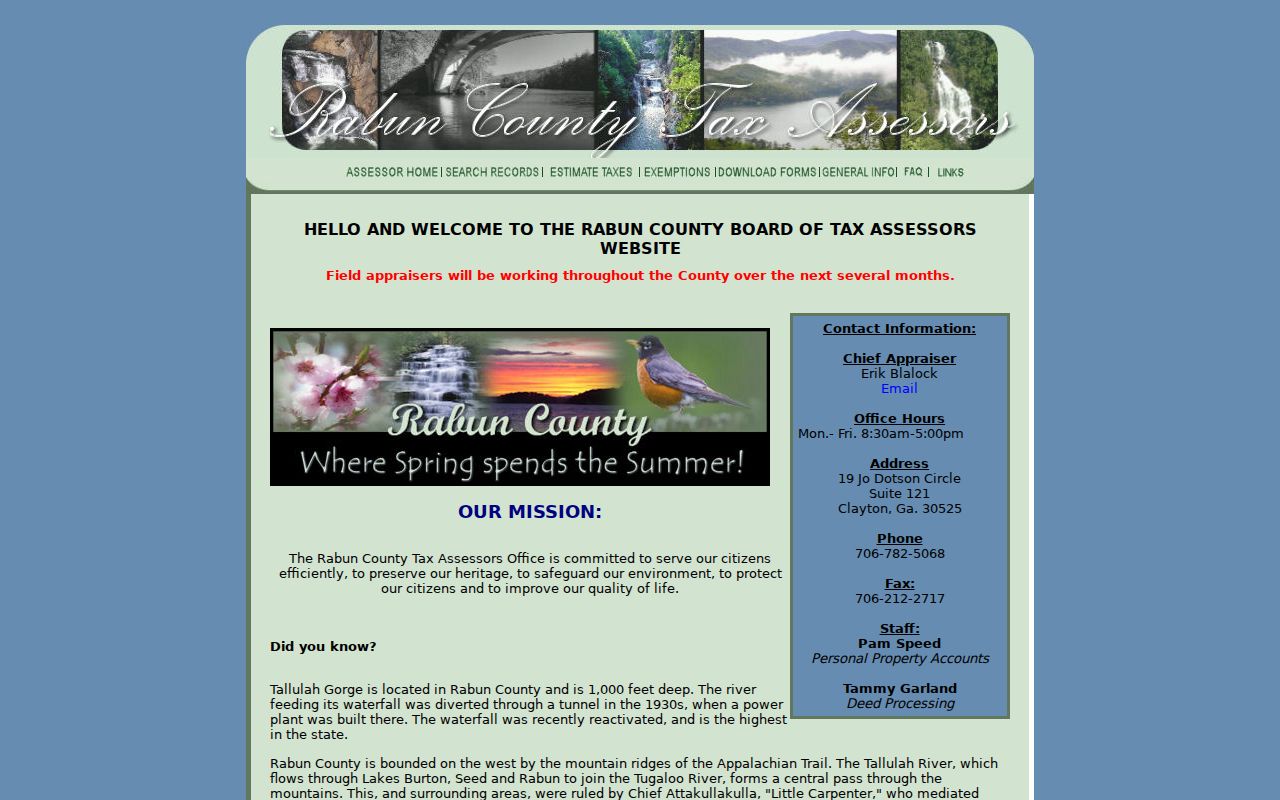
An entry page is not proof of any parcel fact. Confirm the parcel card in the live system and compare it with the newest recorded deed.
Rabun's Recorded Instrument Index
The statewide GSCCCA index offers a detailed form rather than a simple address box. That shape matters. Georgia land research often turns on party role and instrument type. Search names with spelling variants, trusts, estates, and business suffixes in mind. A name of two characters or fewer requires a county, an instrument type, and a date span of one year or less.
| Control | Rabun Search Use | Format or Choice |
|---|---|---|
| Party Type | Separate transferor from recipient | All Parties, Grantor, Grantee |
| Instrument Type | Narrow deeds, liens, easements, or releases | All Instruments or a named filing |
| County | Limit results to the local index | RABUN |
| Name | Find a person or entity | Last name, first name for individuals |
| Date Range | Focus the transfer period | mm/dd/yyyy or mm-dd-yyyy |
| Display | Set page size and table layout | 5 to 100 rows; three layouts |
The GSCCCA page displays a central-index span from January 1, 1990 through August 4, 2026. That range does not guarantee every Rabun image is online. The county good-through-date link, the deed room, and the actual document image give the sound answer.
Rabun Property Record Types
A full property inquiry can touch several record groups. The deed proves a recorded transfer. The assessment roll identifies the parcel and the values behind the tax bill. A tax bill shows what was charged and collected. Plats and easements describe the land, while permit or court records explain other events. Read each source for the role its custodian plays.
| Record Type | What It Documents | Kept By | Access |
|---|---|---|---|
| Deeds and transfers | Parties, legal description, recording date, book/page | Clerk of Superior Court | GSCCCA, deed room, copy request |
| Liens and security deeds | Recorded claims, financing, releases | Clerk of Superior Court | Index, image account, counter |
| Assessment roll | Parcel, owner display, values, exemptions | Board of Assessors | qPublic or assessor office |
| Tax bills | Charges, payments, delinquency trail | Tax Commissioner | Tax portal or office |
| Plats and permits | Lot layout, approvals, work snapshot | Clerk and Planning | Books, document library, request |
Use Rabun County deed records when the question is who conveyed title or what the legal description says. Turn to the assessment and bill systems for value, exemptions, or tax status. Permit records can name a listed owner or parcel, but neither field substitutes for the vesting deed.
Rabun Assessment and Tax Clues
Rabun County's Board of Assessors sets fair market value each January 1. Georgia law then cuts that figure to 40 percent for the assessed value. A mill equals one dollar per $1,000 of assessed value. These are tax terms, not market offers. Neither fair market value nor assessed value matches a current sale price. Nor do they match an independent appraisal.
The filing window for property returns opens January 1. It closes April 1. The qPublic FAQ lists December 1 as the due date for bills. Homestead and current-use programs carry their own application rules and deadlines. The county forms page does contain stale references to other counties. So confirm eligibility and the correct form with the Rabun office before acting.
- Fair market value
- The assessor's estimate of value as of the statutory date.
- Assessed value
- Forty percent of fair market value in Georgia.
- Mill
- One dollar of tax for each $1,000 in assessed value.
- APN
- The parcel identifier used to keep the same land tied across records.
Note: Compare both fields, since assessed value and millage can move in opposite directions at the very same time.
Rabun Tax Bills and Appeals
The Tax Commissioner collects the bill. The Board of Assessors sets the value behind it. That split explains why a billing question and a valuation question can land at different counters in the same Jo Dotson Circle complex. The official tax site links out to GovernmentWindow, a dynamic search-and-pay service. Its exact fields are not published. When the portal stalls, take the question straight to the office.
An assessment notice starts a 45-day appeal window. Rabun's instructions accept taxability, value, or uniformity as grounds. Review begins with the Board and can continue to the Board of Equalization, arbitration, or Superior Court. Keep the notice date, parcel number, claimed value, chosen ground, and proof of timely filing, because bill due dates never extend the separate appeal clock.
Watch the notice date. The assessment appeal window is 45 days, and the notice controls when that period starts.
Rabun Maps Need Recorded Plats
qPublic serves as Rabun County's parcel-map platform. The map helps you locate an APN and its neighboring parcels. It offers no documented buffer tool, adjacent-parcel control, downloadable GIS service, or confirmed layer list. If the viewer blocks you, call the assessor for a parcel map or map-book reference. The county document library holds published plans too.
A parcel line on screen is a reference. It settles no boundary. Ask the Clerk for the recorded plat, survey, easement, right-of-way instrument, or boundary-line agreement, cited by book and page. Lake, creek, forest, shared-drive, and steep-terrain descriptions often sit at the center of a Rabun dispute. A licensed surveyor applies them on the ground.
Exact APNs matter just as much. The April 2025 permit list carries patterns like 014C 004, LN002 006L, and 042A 045B, so preserve spaces, letters, and suffixes rather than forcing every Rabun parcel into one numeric format.
Rabun Property Filing Alerts
GSCCCA's Filing Activity Notification System, called FANS, watches for selected filings as they happen. It launched in January 2023. State program reporting counted about 85,000 users by June 30, 2025. You can build criteria from names, addresses, or document information for property you own or are authorized to monitor.
FANS is not a historic deed search. It depends on a participating Clerk's indexing. Transmission can lag, and the service never guarantees an alert is complete, accurate, or current. Pair each alert with the recorded image. The Clerk's index is the backup. The public FANS landing page is where alerts begin, and the Georgia Attorney General points owners there for title-theft and suspicious solicitation concerns.
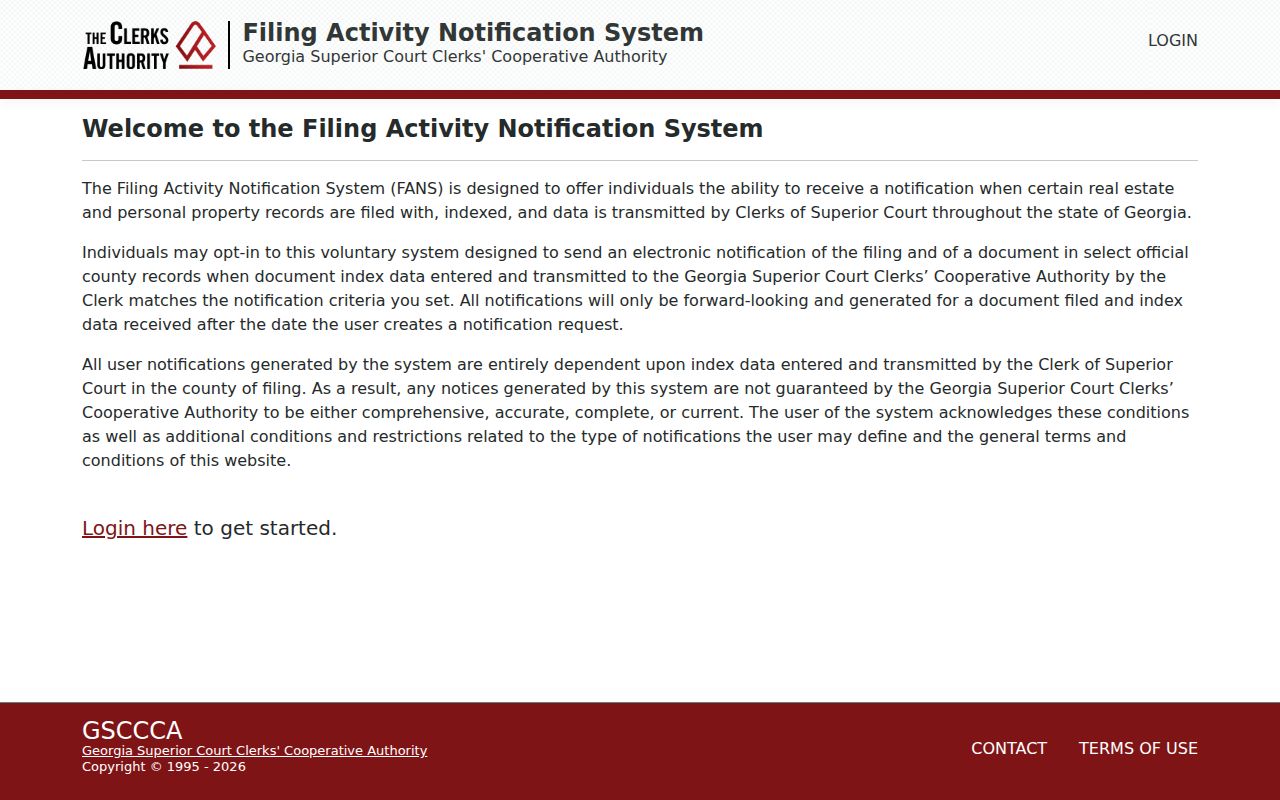
The landing page opens an alert account. It will not trace an older ownership chain or undo a questionable filing.
Rabun's Historic Deed Trail
Modern online coverage is only one layer of Rabun property records. The FamilySearch catalog reaches much further. It lists deed books beginning with a volume labeled 1801 to 1811, and general indexes running roughly from 1800 through 1920. The Georgia Archives may hold microfilm or digital copies. Local custody still matters. Confirm catalog dates against the book itself.
The Rabun Historical Society keeps abstracts of original 1820 land-lottery titles and a hand-drawn land-lot map. From those pages, record the lot, district, grantee, acreage, date, adjoining names, and any later deed citation. That lead carries you into the county deed books. An abstract is a finding aid. It is not a certified title record, and neither is the old land-lot map.
The catalog opens the older path for pre-index names.
Rabun Newspapers Bridge Record Gaps
The Rabun County Public Library and local historical collections can explain names that an index line alone cannot, and the Georgia library holdings guide reports a Clayton Tribune run surviving from 1899 to the present. Georgia Historic Newspapers adds 656 searchable issues. Those span June 22, 1899 through December 18, 1924.
Search a surname, road, subdivision, sheriff's sale, estate sale, tax sale, or court order. Record the issue date and page. Then confirm the event in the deed, plat, tax, probate, or court file. Newspapers may surface an older road name. They may also expose the public notice behind a transfer. They never replace the official instrument.
When Rabun Portals Fail
Some Rabun County portals simply do not cooperate. qPublic and the tax portal restrict open access. The local court search requires a login and a CAPTCHA. FANS hides its criteria form until you hold an account. GSCCCA images may require a paid account. Plan a fallback chain instead of guessing at field labels.
The Clerk's deed room holds the deed and plat books. You can also call the assessor or the Tax Commissioner. A narrow written request works just as well. The Georgia Open Records Act FAQ spells out the timeline. An agency generally responds within three business days. You may get the records, a production schedule and cost estimate, or a legal basis for withholding. The agency need not create a new report. So ask for an existing parcel card, permit log, map, or file. Include the APN, address, record type, date span, and preferred format.
For older material, Georgia Archives, FamilySearch, the local library, and the Historical Society work well as finding aids. Return to the proper county custodian whenever you need the official copy.
Rabun Estates and Court Transfers
A routine sale is not the only path. Estates, foreclosures, and lawsuits all move deeds too. The GSCCCA instrument menu lists several deed types. These include deeds from estates, foreclosure deeds, sheriff's deeds, and tax sale deeds. Trustee's deeds, court orders, and estate documentation appear there as well. Probate papers can identify an executor, an administrator, heirs, or the authority to convey. Quiet-title and boundary suits may explain a court-ordered change or a disputed legal description.
Check the Clerk's recorded index for the resulting land instrument. The WebCaseSearch gate keeps its search controls from public view. The counter remains the reliable fallback for case context. Allegations in a complaint are not findings. And a sale notice never proves a sale closed.
Limits of Rabun Property Records
Rabun County property records can do a lot. They identify an assessed parcel and show a recorded conveyance. They reveal liens of record and document a tax charge. They also point to plats or permit files. But they cannot prove the assessor roll has already caught up with a recent deed. A GIS line is not a survey. An index entry is not the full instrument. An assessed value is not a sale appraisal.
Collect only the facts lawful parcel research needs, and remember Georgia provides no general Rabun opt-out from the deed index or the parcel roll. Special protections can cover other records. VoteSafe shields a qualifying voter's residence in public voter data. Never try to defeat an address protection. Do not assume the owner of record lives there now.
Lawful use. Rabun County records support purchase research, boundary work, tax review, estate work, and civic oversight. They must never be used to stalk, harass, threaten, or harm anyone.