
Read Rabun Deed Records
Every Rabun County deed record begins with an instrument. That instrument vested title in the named grantee. The Clerk of Superior Court records deeds, security deeds, plats, liens, releases, easements, powers of attorney, UCC filings, and other real-estate papers. Online access runs through the statewide GSCCCA index. For older material, the Clerk's deed room holds the deed and plat books. Those books support counter research.
| Deed Type | What It Does | Common Use |
|---|---|---|
| Warranty deed | Conveys the described interest with stated covenants | Ordinary arm's-length conveyance |
| Quit claim deed | Conveys whatever interest the grantor may hold | Interest release or chain cleanup |
| Gift deed | Transfers land as a gift | Non-sale family or estate planning transfer |
| Deed from estate | Conveys under estate authority | Executor or administrator transfer |
| Foreclosure, sheriff, or tax sale deed | Records a transfer through a special legal process | Distressed or court-linked chain |
Not every filing transfers ownership. A security deed is a financing instrument, not the vesting deed itself, and liens, cancellations, and releases shape the record without changing the owner of record. Read the instrument type, the parties, the legal description, and any cited prior deed before treating an index row as a transfer.
Rabun's GSCCCA Instrument Menu
The GSCCCA real-estate name form lets you set Party Type, Instrument Type, County, name, dates, row count, and table layout. Its instrument menu is unusually broad. Alongside the standard deed types, it covers boundary-line agreements, easements, right-of-way deeds, restrictive covenants, estate documents, court orders, leases, timber instruments, liens, materialman's liens, notices, powers of attorney, releases, and cancellations.
| Search Control | Verified Choices | Deed Research Use |
|---|---|---|
| Party Type | All Parties, Grantor, Grantee | Separate giver from recipient |
| Instrument Type | All Instruments or named filing | Distinguish transfer from lien or release |
| County | RABUN or another Georgia county | Set the recording jurisdiction |
| Name | Last name, first name for individuals | Find a party with spelling variants |
| Date | Optional from and through dates | Focus on a likely transfer period |
A short query of two characters or fewer requires a county, an instrument, and a date range. That range can be no longer than one year. The form accepts mm/dd/yyyy or mm-dd-yyyy and rejects years before 1850. Those validation limits say nothing about local deed coverage. The official name-search form shows the controls used for Rabun deed records.
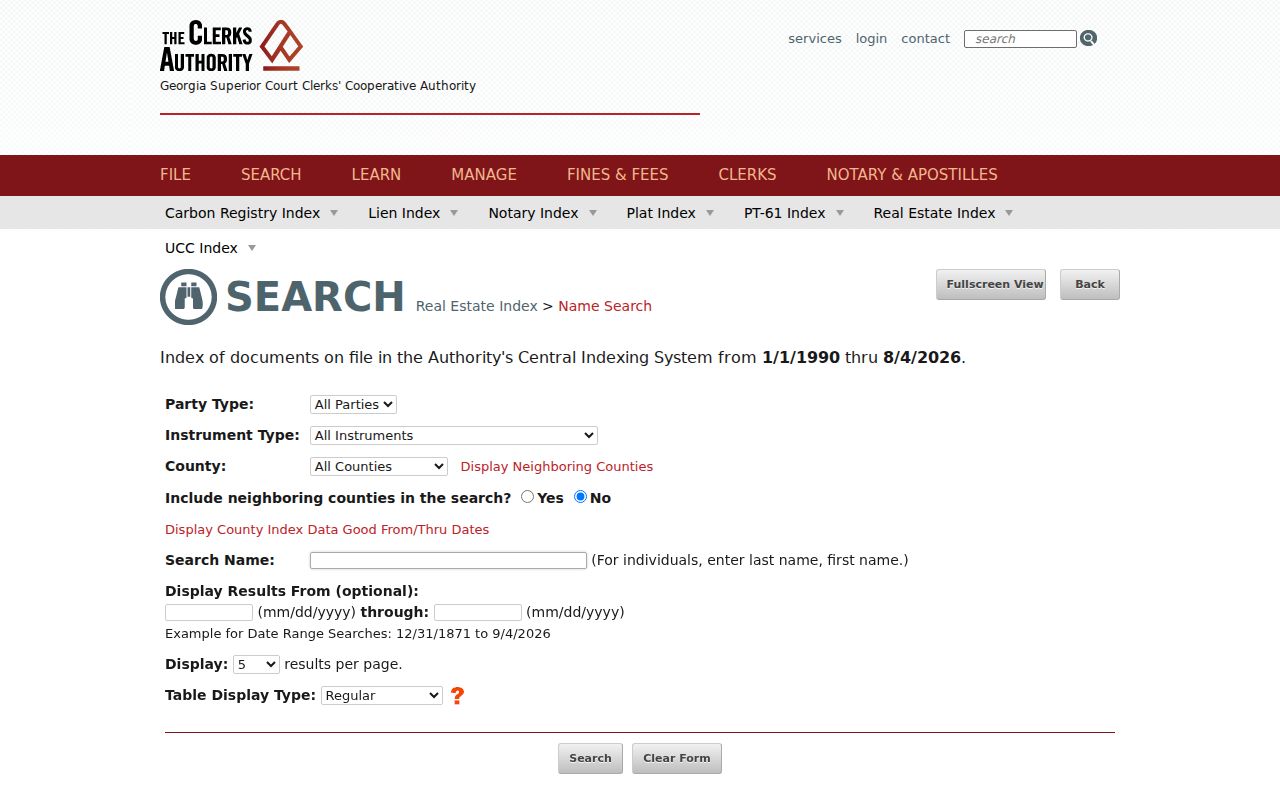
The screen supports a precise party and instrument search, though a sample Rabun result is worth opening to confirm what the index returns.
Walk Rabun's Grantor-Grantee Chain
Start a chain with the parcel and its latest likely owner. Work backward through the recorded parties from there. The assessor display is a clue, not the final title answer. Rabun County publishes no fixed deed-to-roll update period. Compare the newest relevant instrument's land description with the parcel before stepping back another generation.
- Copy the owner name and APN from the current assessor entry.
- Search that name as Grantee in Rabun County over a recent, reasonable date span.
- Open the likely vesting deed and record the grantor, grantee, date, instrument type, book/page, and full description.
- Search the grantor as a Grantee in the earlier period, then repeat the comparison for the same land.
- Move to deed books, Archives, or FamilySearch when the chain precedes the central index.
- Grantor
- The party that conveys or releases an interest.
- Grantee
- The party that receives the stated interest.
- Chain of title
- The linked sequence of instruments for the same land.
- Book and page
- The recorded volume and page citation used to retrieve an instrument.
- Instrument number
- A separate filing identifier that may appear in a modern index.
At each step, match acreage, lot and block, subdivision, land lot and district, plat citations, easements, and adjoining owners. A parcel split can change the APN. The deed chain still runs through the description.
Book and Page Bridges Rabun Records
The GSCCCA Book Page Search asks for county, book, and page. It reformats entries to its indexing standard automatically. Use it when a deed, plat, assessor card, or later instrument already supplies a citation. It beats a broad name search, because the source has already pinpointed the recorded location.
Record both the book/page and any instrument number. A deed often cites a prior deed in its legal description. That citation is the best bridge through a name change or entity transfer. A plat book page can tie a deed to a subdivision lot. It can also point to a road dedication, an easement, or a revised boundary. The GSCCCA book-page screen shows the required retrieval fields.
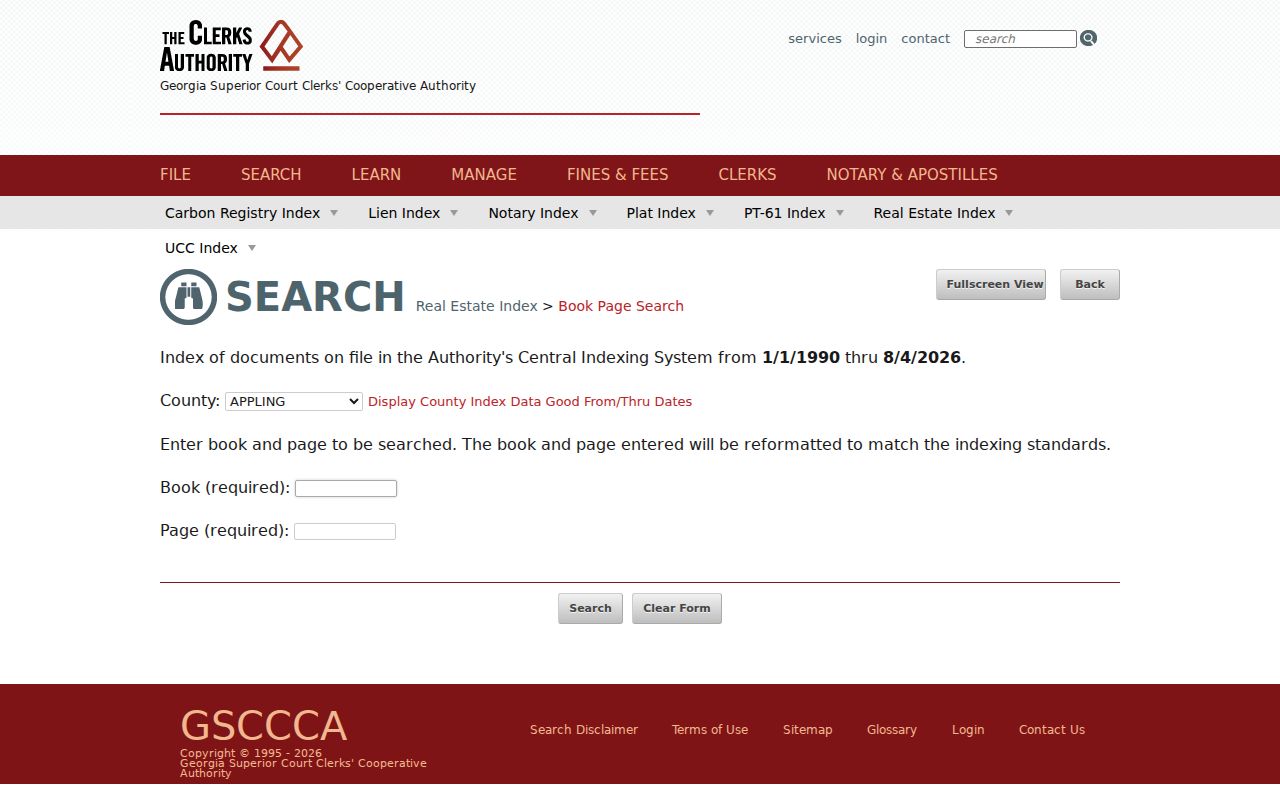
Remember, the form only helps once a citation is in hand; it never replaces the grantor-grantee search.
Rabun's 1990 Index Trap
The live name page displays documents on file from January 1, 1990 through August 4, 2026, and the form itself carries older system date examples while rejecting years before 1850. Those numbers can mislead. They do not prove that Rabun County deed records exist online across the whole span, and they establish nothing about county-specific image coverage. Check the GSCCCA county good-from and good-through link for the local index status. If the chain predates the digital range, go to the Clerk's deed room and the historical books. Georgia Archives may hold selected microfilm or Virtual Vault material, and the FamilySearch catalog identifies Rabun deed books beginning in 1801.
Coverage warning. The displayed central-index date is not a promise that every Rabun deed or image within that period is online.
Rabun Deed Books Reach 1801
The FamilySearch Rabun catalog lists an early book labeled V1 covering 1801 to 1811. V2 covers 1810 to 1823, and later volumes follow. It also points to general indexes running roughly from 1800 through 1920. These are catalog descriptions, so image access may require an account. Some sets must be browsed book by book and page by page.
The Rabun Historical Society holds abstracts tied to original 1820 land-lottery titles. It also keeps a hand-drawn land-lot map. Capture the lot, district, grantee, date, acreage, and any later deed reference. Then carry that lead into the official books. Georgia Historic Newspapers and the Clayton Tribune can supply sale notices or older road names. The deed itself remains the transfer evidence. The catalog page illustrates the older volume route.
A blank modern name search is not the end of the road. It should push you toward the books and indexes rather than any claim that no deed exists.
Plats and Easements in Rabun Deeds
Deed descriptions in Rabun County take several forms. Some cite a subdivision lot, block, or recorded plat. Others lean on land lot and district numbers, raw acreage, or metes and bounds calls that trace roads, ridges, creeks, and adjoining owners. Mountain and lake parcels add their own wrinkles, since a shared drive, access easement, right of way, stream line, conservation restriction, or timber interest can shape how the land is used.
Pull any plat citation from the Clerk's plat books. Read the title, phase, surveyor, and recording date. Note lot dimensions, roads, dedications, easements, restrictions, and revision notes. A map image is only a reference aid. When a boundary or access dispute is real, retrieve the recorded documents and consult a licensed surveyor or lawyer as the issue requires.
Note: A security deed may repeat the same legal description as the vesting deed, yet it records financing rather than a conveyance of ownership.
FANS Watches Future Rabun Filings
The Filing Activity Notification System, known as FANS, alerts authorized users when selected real-estate or personal-property records are filed. Participating clerks then index and deliver them. The system launched in January 2023. State reporting put its user count near 85,000 by June 30, 2025. Criteria can involve names, addresses, or document details.
FANS looks forward only. It does not rebuild deed records from the past. The service itself warns that alerts ride on Clerk index data. They are not guaranteed complete or current. Inspect the actual image. Compare signatures and legal descriptions. Contact the Clerk about anything suspicious. An alert by itself cannot remove or correct an instrument.
Get a Rabun Deed Copy
Start by gathering the basics. You will want Rabun County, the party names, instrument type, recording date, and a book/page or instrument number. Check the GSCCCA image service for indexed records. You can also visit the Clerk at 25 Courthouse Square, Suite 201 in Clayton. The deed room keeps the deed and plat books. For a mail request, state the citation. Say whether a plain or certified copy is wanted.
Confirm the cost before ordering. The county real-estate page and a newer filing-fee PDF post conflicting deed amounts. The GSCCCA account pages list $29.95 monthly Premium access. A $5 four-hour Single Use account is one option. A $0.50 per printed page charge rounds out the online options. Those figures are service terms for the site. They are not a guaranteed Clerk copy or certification fee.
Recorded, not guaranteed. Rabun deed records show instruments accepted for recording. An index hit is not a title opinion, and unrecorded or misindexed interests may require legal review.
Start with the Rabun County property search. Use it when no owner name or book/page is known, and once a citation turns up, the Clerk remains the source for an official certified copy.