
Find Out Who Owns a Rabun County Property
The address is a clue, not the answer. Rabun County splits the ownership trail between the Board of Assessors' qPublic roll and the Clerk of Superior Court's recorded instruments. Follow one parcel across both:
- Enter the situs address in the Rabun qPublic parcel search.
- Copy the displayed owner, APN, situs, mailing address, and legal-description clues exactly.
- Search the vesting name as a recent grantee in the GSCCCA real-estate index, limited to Rabun County.
- Match dates, parties, book/page, acreage, subdivision or land-lot description before identifying who owns it.
The qPublic owner display can vary by screen. If it fails, call the Assessor at 706-782-5068 or visit 19 Jo Dotson Circle, Suite 121, Clayton.
Use a Rabun Address to Recover the APN
Postal labels can mislead in Rabun County. Clayton 30525, Mountain City 30562, and Tiger 30576 are mailing clues, not proof of city jurisdiction. Rural routes and parcel splits also defeat street searches. Every letter, zero, space, and suffix matters. Official permit examples such as 014C 004 and LN002 006L prove the point. For a new or uncertain address, Rabun County E911 mapping answers questions at 706-960-9753.
Read the Assessor Owner Entry Carefully
The assessor roll anchors any owner search. Record what it actually shows: the owner name, mailing address, situs, parcel number, legal description, values, exemptions, and any sale or deed reference. It is a tax document, not a deed. Rabun County publishes no fixed owner-field label or refresh schedule for the roll, so treat both as variable rather than settled.
- Owner of record
- The party carried on a government record; it may not reflect a just-recorded transfer immediately.
- Situs address
- The property's physical-location label.
- Mailing address
- Where assessment correspondence goes; it does not prove occupancy.
- Grantee
- The party receiving an interest in a deed.
Note: Compare actual dates instead of promising a standard deed-to-roll update period.
Where Rabun County Ownership Clues Live
No single screen answers every ownership question. Each official source has a narrower role.
| Source | Owner Info It Gives | Access |
|---|---|---|
| Assessor roll | Displayed owner, APN, situs and mailing clues | qPublic or Assessor counter |
| Latest deed | Grantee, grantor, date, book/page and legal description | GSCCCA or Clerk deed room |
| Business filing | Entity name, control number, agent or officer clues | Georgia SOS search |
| Parcel layer | Mapped assessment tract | qPublic reference map |
When the roll and a recent transfer disagree, the newest matching deed is the stronger confirmation. A tax mailing entry is not a deed. A parcel-map label is not a title opinion.
Identify LLC, Trust, and Estate Owners
The owner of record may be an entity. Search the vesting text exactly as written, including LLC, trust, estate, executor, administrator, or trustee. For a company, the Georgia Secretary of State Business Search covers business name, control number, registered agent, officer, and designated-agent queries. A corporate filing explains an entity's name. It never proves ownership of a parcel. Estate transfers surface as a deed from estate, a court order, or a trustee's deed. Match the recorded legal description every time.
Separate Security Deeds from Ownership Deeds
Not every indexed deed conveys ownership. GSCCCA lists warranty, quitclaim, gift, estate, foreclosure, tax-sale, trustee's, and security instruments. A security deed records financing. It does not vest title. Releases and cancellations only clear encumbrances, so trust the newest conveyance into the grantee and compare its description; instrument and copy guidance sits in Rabun deed records.
Watch for Future Rabun Filings
Once the owner of record is known, the GSCCCA Filing Activity Notification System sends name-based alerts about future filings. FANS launched in 2023. It depends on Clerk transmission, so it is no substitute for a complete historical deed search and no guarantee of notice. The official alert landing page displays the service.
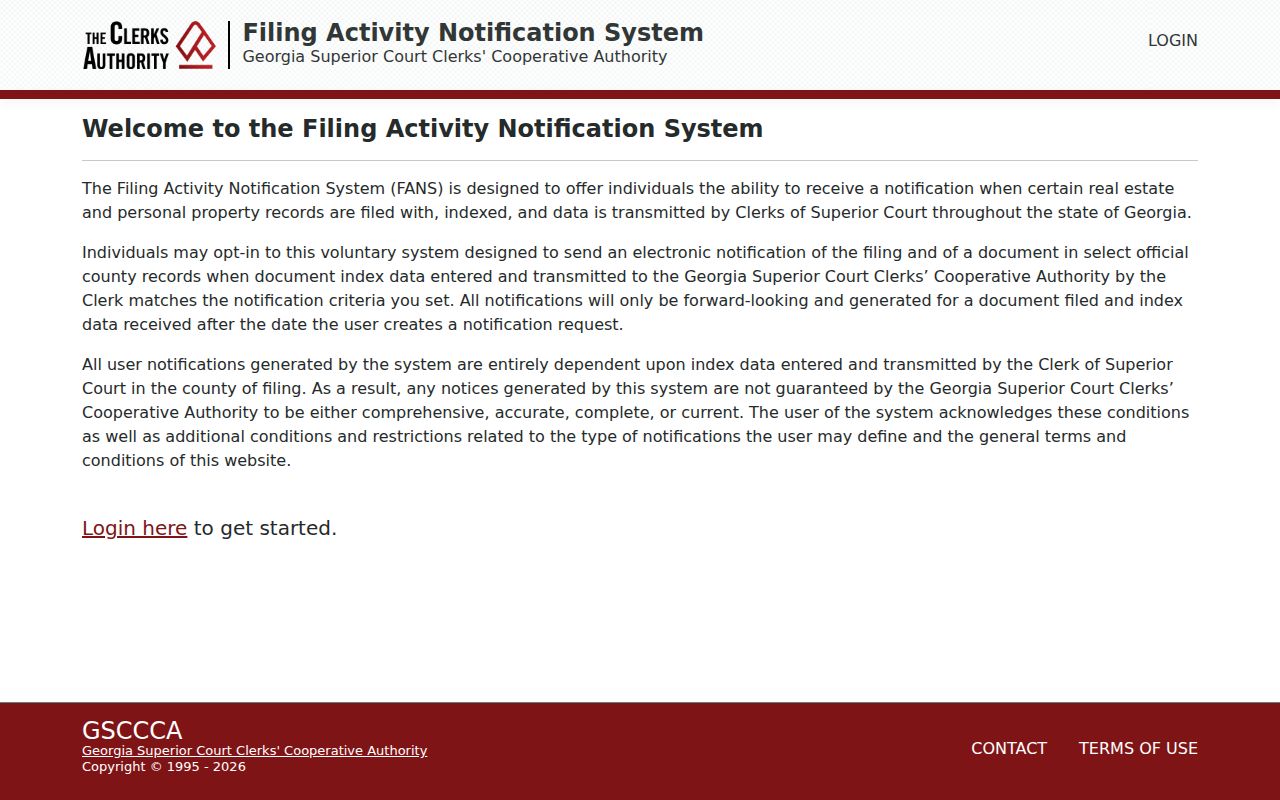
Treat an alert as a reason to inspect the actual index and recorded instrument.
What a Rabun Ownership Lookup Cannot Establish
The trail stops at names. It can identify the tax-roll owner and the recorded deed grantee, yet it cannot prove occupancy or expose an unrecorded claim. Trust interests and marketable title stay out of reach.
Owner name is not a title search. The roll may lag, an entity may hold the interest, and a same-name match can identify the wrong tract. Confirm the deed and obtain professional title work when needed.
Lawful uses abound. Owner information supports parcel verification, purchase diligence, boundaries, estate research, and civic transparency, never stalking, harassment, threats, or exposing someone.
Finish the Owner Search at the Rabun Counter
Both offices take counter research. The Assessor sits at 19 Jo Dotson Circle, Suite 121, Clayton. Hours are Monday through Friday, 8:30 to 5. The Clerk's deed room is at 25 Courthouse Square, Suite 201, telephone 706-782-3615. Bring the address, parcel number, owner spelling, transfer date, and any book or page clue. Mail works for copies. State the book and page or instrument number, and ask for current charges, because official fee pages conflict. Non-online maps and permits can be requested under the Georgia Open Records Act. Older land leads can continue through the Georgia Archives. Current recorded ownership returns to the Clerk.
Note: Save the query date, URL, spelling, APN, instrument reference, and access limitation with every result.
Resolve Same-Name and Same-Street Matches
A surname hit statewide proves little. Limit the search to Rabun County, set a plausible date window, and compare grantor, grantee, deed type, book and page, acreage, subdivision, land lot, and adjoining references. GSCCCA wants individual names in last-name, first-name form. Grantor, Grantee, and All Parties searches are offered. Short queries need extra narrowing. That is one more reason to start from the parcel, not a name fragment.
Shared streets and changed rural addresses complicate matches. The parcel number and legal description keep the ownership method anchored. A split may create successor parcel numbers, so consult the recorded plat and the predecessor deed instead of rejecting an otherwise consistent chain. Document why the chosen record matches and why near-names do not.
Account for Index and Image Access
The GSCCCA public index will hand you citations for free. Viewing images is a different matter. Premium access runs $29.95 per month, Single Use costs $5 for four consecutive hours, and printing adds $0.50 per page, so confirm live pricing before buying. The Clerk's published recording-fee sources disagree with each other. Call the office for current copy and certification charges. Remember that an index citation, a screen image, an ordinary copy, and a certified copy each carry different evidentiary weight.
Choose the Shortest Owner-Finding Route
Your starting clue should set your route. An address alone points to the assessment parcel first. A known APN is even better. It sidesteps postal and street-name ambiguity in one step. With only an owner name, qPublic may offer an intended owner route, though its live controls vary; GSCCCA can search that person as grantor, grantee, or all parties. A book/page citation, meanwhile, jumps straight to the recorded reference you need.
| Starting clue | First move | Cross-check |
|---|---|---|
| Street address | Find the qPublic parcel and APN | Match legal description in latest deed |
| Parcel number | Open the assessment tract | Compare predecessor APN if split |
| Owner or entity name | Search name variants and county | Match APN, parties, date, and land |
| Book and page | Use GSCCCA book-page search or Clerk | Verify current grantee and description |
Every route still ends at the same checkpoint. The newest plausible ownership deed must actually describe the subject land. Never merge two parcels just because an owner name or mailing address happens to match.
Record the Owner Answer with Its Limits
A defensible answer names the displayed assessment owner, the source date, the APN, the situs, and the latest matching deed citation. It also flags any unresolved limitation. A portal may be down, an image may sit behind an account, or the deed may not yet appear on the roll. Entity ownership, a missing legal description, or conflicting parcel identifiers belong on that list too. A bare name with no provenance says almost nothing.
A transaction or contested right demands more. A professional title search can surface liens, easements, probate interests, court orders, or unrecorded issues outside this basic method. The public route identifies a likely record owner. It does not insure title or settle a dispute.